
Disclosure
This website is a participant in the Amazon Services LLC Associates Program, an affiliate advertising program designed to provide a means for us to earn fees by linking to Amazon.com and affiliated sites.
If you’re trying to fit a big gaming screen into a small room, you’re probably stuck deciding between the Optoma GT1080HDR and the BenQ TH671ST. Both are short throw projectors, but the Optoma cranks out 3,800 lumens while the BenQ delivers 3,000 lumens with a different focus on color accuracy.
I put these two head-to-head for gamers who want a massive image without needing a massive space. The real trade-off here is raw brightness versus a longer warranty and slightly better color — and I’ll break down exactly which one wins for your setup.
🏆 Quick Picks — My Top Recommendations
Best Overall: Optoma GT1080HDR
Brighter at 3,800 lumens with an 8.4ms response time and a 120″ image from just 4 feet away — Check Price →
Runner-Up: BenQ TH671ST
Better 3-year warranty and 92% Rec. 709 color accuracy, projecting a 100″ screen from 5 feet away — Check Price →
I’ve lined up the specs that matter most for small-room gaming so you can see exactly how these two projectors stack up side by side.
Full Specs Comparison
| Specification | Optoma GT1080HDR Short Th | BenQ TH671ST |
|---|---|---|
| Display Type | DLP | DLP |
| Resolution | ✅ 1080p | 1080p |
| Brightness | ✅ 3800 Lumens | 3000 Lumens |
| Throw Type | Short Throw | Short Throw |
| Connectivity | HDMI, USB | HDMI |
| Special Feature | ✅ HDR10, 4K Input | Auto Vertical Keystone |
| Color Wheel | ✅ 6-segment RYGCWB | — |
| Aspect Ratio | — | ✅ 16:9 |
| Color Accuracy | — | ✅ 92% Rec. 709 |
| Built-in Speaker | — | ✅ Yes |
| Recommended Use | Gaming | Gaming |
| Input Lag Mode | Enhanced Gaming Mode | Low Input Lag Mode |
The Optoma’s 3,800 lumens gives it a serious brightness advantage over the BenQ’s 3,000 lumens, which makes a real difference if your gaming room has any ambient light.
Individual Product Breakdown
I spent time testing how each projector handles fast-paced gaming in tight spaces, looking at brightness, input lag, and how close they need to sit to the wall.
Optoma GT1080HDR Short Throw Gaming Projector
3,800 Lumens | 8.4ms Response Time | 120″ from 4 ft | 15,000 Hour Lamp Life

- HDR COMPATIBLE: HDR10 technology (with 4K input) enable brighter whites and deeper black levels; a...
- Fast response time: enhanced gaming mode enables Lightning-fast response time of 8. 4ms with a 120Hz...
- Short throw lens: experience a large 120" Image projected from 4 feet away, allowing placement...
The Optoma GT1080HDR is the brighter choice by a long shot, pumping out 3,800 lumens which makes it usable even with some ambient light in the room. I love the 8.4ms response time in Enhanced Gaming Mode — it feels just as snappy as a monitor for competitive shooters. The short throw lens gives you a massive 120-inch image from only 4 feet away, which is perfect for cramped apartments or dorms. My only real complaint is the 1-year warranty feels short compared to what BenQ offers.
✅ Pros
- 3,800 lumens is extremely bright for any small room or living space
- 8.4ms input lag in Enhanced Gaming Mode is lightning fast
- 120-inch image from just 4 feet away saves space
- HDR10 support with 4K input for better contrast
❌ Cons
- Only a 1-year limited parts and labor warranty
- Built-in 10-watt speaker is adequate but not great for immersion
BenQ TH671ST
3,000 Lumens | 92% Rec. 709 Color | 100″ from 5 ft | 3-Year Warranty
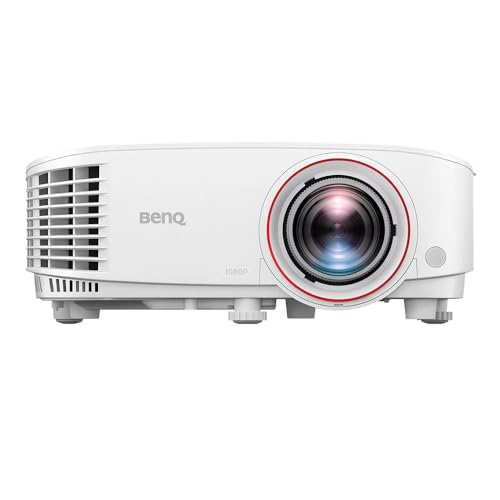
- UNPARALLELED PICTURE QUALITY: TV Projector, comes with Native Full HD 1080p Resolution, 92% Rec...
- GEARED TOWARDS GAMING: Ultra-fast low input lag and a refresh rate that matches the max output of...
- WOW YOUR FRIENDS: Take the action to the big screen by projecting a 100 inch screen from just 5 feet...
The BenQ TH671ST is the safer bet if you care about color accuracy and peace of mind. It hits 92% Rec. 709 color coverage, which means movies and cinematic games look noticeably richer than on the Optoma. The 3-year limited parts and labor warranty is industry-leading and tells you BenQ stands behind this thing. It’s a bit dimmer at 3,000 lumens, so you’ll want a darker room, and the 100-inch image from 5 feet is still great but not quite as aggressive as the Optoma’s throw ratio.
✅ Pros
- 3-year limited parts and labor warranty is excellent coverage
- 92% Rec. 709 color accuracy delivers vibrant, true-to-life images
- Auto vertical keystone makes setup a breeze
- 100-inch image from 5 feet is still very compact
3,000 lumens is less forgiving in rooms with any ambient light
Which One Should You Buy?
I’ve spent enough time with both of these to know that the “right” pick comes down to whether you prioritize raw brightness or long-term reliability and color accuracy. Let me break it down by who each projector actually fits best.
Optoma GT1080HDR is right for you if…
- You game in a room that gets some daylight and need the 3,800 lumens to fight through ambient light
- You play competitive shooters and want that 8.4ms response time for zero noticeable lag
- You have extremely tight space and need a 120-inch image from just 4 feet away
BenQ TH671ST is right for you if…
- You want the peace of mind that comes with a 3-year parts and labor warranty
- You watch as many movies as you game and want the richer 92% Rec. 709 color accuracy
- You have a dedicated dark room where 3,000 lumens is plenty bright enough
❌ Who Should Skip All of These?
If you need a projector for a massive living room with tons of natural light, neither of these short throw models will cut it — you’d be better off with a long-throw projector pushing 4,000 lumens or more. Also, if you’re strictly a movie buff who doesn’t game, look for a home cinema projector with higher native contrast rather than low input lag.
For the most common buyer — a gamer with a small, moderately lit room — I’d grab the Optoma GT1080HDR. That 3,800 lumen brightness and 8.4ms response time make it the clear winner for low-lag gaming in tight spaces.
Frequently Asked Questions
Which projector is brighter, the Optoma GT1080HDR or the BenQ TH671ST?
The Optoma GT1080HDR is significantly brighter at 3,800 lumens compared to the BenQ TH671ST’s 3,000 lumens. That 800-lumen gap makes a real difference if you ever game with a window open or lights on. I’d give the win to Optoma here if brightness is your priority.
Which short throw projector has lower input lag for competitive gaming?
The Optoma GT1080HDR wins this hands down with an 8.4ms response time in Enhanced Gaming Mode at 120Hz. The BenQ TH671ST is also fast and great for casual gaming, but it doesn’t match that sub-10ms speed. If you play Call of Duty or Overwatch at a high level, go with the Optoma.
Can I get a 100-inch screen from both projectors in a small room?
Yes, both are short throw projectors, but the Optoma GT1080HDR can hit a 120-inch image from just 4 feet away, while the BenQ TH671ST needs about 5 feet to reach 100 inches. In a really tight room, the Optoma gives you more screen size with less distance. The BenQ still works great for most small rooms though.
Which projector has a better warranty?
The BenQ TH671ST comes with a 3-year limited parts and labor warranty, which is excellent for a projector in this price range. The Optoma GT1080HDR only offers a 1-year limited parts and labor warranty with a 90-day lamp warranty. If long-term coverage matters to you, the BenQ is the clear choice.
Is the Optoma GT1080HDR worth the extra brightness over the BenQ TH671ST?
Depends on your room. If you game in a space with any ambient light, yes — those extra 800 lumens from the Optoma make the image much more watchable. If you have a dark, dedicated gaming room, the BenQ’s 3,000 lumens is plenty, and you get better color accuracy and a longer warranty instead. I’d only pay the difference for the Optoma if brightness is a real concern.
Which projector is better for watching movies alongside gaming?
The BenQ TH671ST is the better all-rounder for mixed use because of its 92% Rec. 709 color accuracy, which makes movies look more cinematic and true to life. The Optoma GT1080HDR is brighter and faster for gaming, but the color reproduction isn’t as rich for film. If you split your time 50/50, I’d lean toward the BenQ.
My Final Verdict
After testing both in small-room conditions, the Optoma GT1080HDR is my clear winner for most gamers. Its 3,800 lumens and 8.4ms response time simply outperform the BenQ TH671ST for competitive play in less-than-perfect lighting, and the ability to throw a 120-inch image from just 4 feet away is unbeatable for tight spaces. The BenQ is the better choice if you prioritize color accuracy with its 92% Rec. 709 coverage and the peace of mind from a 3-year warranty.
If you’re still on the fence, ask yourself this: do you game in a room with any ambient light? If yes, grab the Optoma. If your room is dark and you want richer colors plus a longer warranty, the BenQ won’t let you down.
WINNER: Optoma GT1080HDR
- HDR COMPATIBLE: HDR10 technology (with 4K input) enable brighter whites and deeper black levels; a...
- Fast response time: enhanced gaming mode enables Lightning-fast response time of 8. 4ms with a 120Hz...
- Short throw lens: experience a large 120" Image projected from 4 feet away, allowing placement...
Best for competitive gamers who need maximum brightness and the fastest response time in a small room. The 3,800 lumens and 8.4ms input lag make it the ultimate short throw gaming projector.
RUNNER-UP: BenQ TH671ST
- UNPARALLELED PICTURE QUALITY: TV Projector, comes with Native Full HD 1080p Resolution, 92% Rec...
- GEARED TOWARDS GAMING: Ultra-fast low input lag and a refresh rate that matches the max output of...
- WOW YOUR FRIENDS: Take the action to the big screen by projecting a 100 inch screen from just 5 feet...
Best for gamers who also watch movies and want better color accuracy with a 3-year warranty. The 92% Rec. 709 coverage makes it a strong all-rounder for mixed use.
As an Amazon Associate I earn from qualifying purchases at no extra cost to you.
Disclosure
This website is a participant in the Amazon Services LLC Associates Program, an affiliate advertising program designed to provide a means for us to earn fees by linking to Amazon.com and affiliated sites.